


From TVs and video games to tablets, smartphones and laptops — screens are, for better or worse, a part of our lives.
But when it comes to monitoring your kid’s screen time, how much is too much?
The answer depends on your child’s age, how they’re using the device and whether screen use is monopolizing time that could be used for healthier activities.
“Screen time can be harmful — but it can also have a place in your child’s life,” says pediatrician Noah Schwartz, MD. “It’s really all about finding a balance and working to address your kids’ specific needs.”
Dr. Schwartz helps us understand screen time recommendations for kids.
What’s considered ‘screen time’?
In the simplest terms, screen time is exactly what it sounds like: time spent looking at a screen (any screen). That includes … ahem, what you’re doing at this very moment.
“Time spent on anything with a screen is screen time,” Dr. Schwartz says.
So, screen time can include time you or your child spends:
- Watching TV
- Playing computer or video games
- Scrolling social media
- Watching videos
- Reading news on your tablet
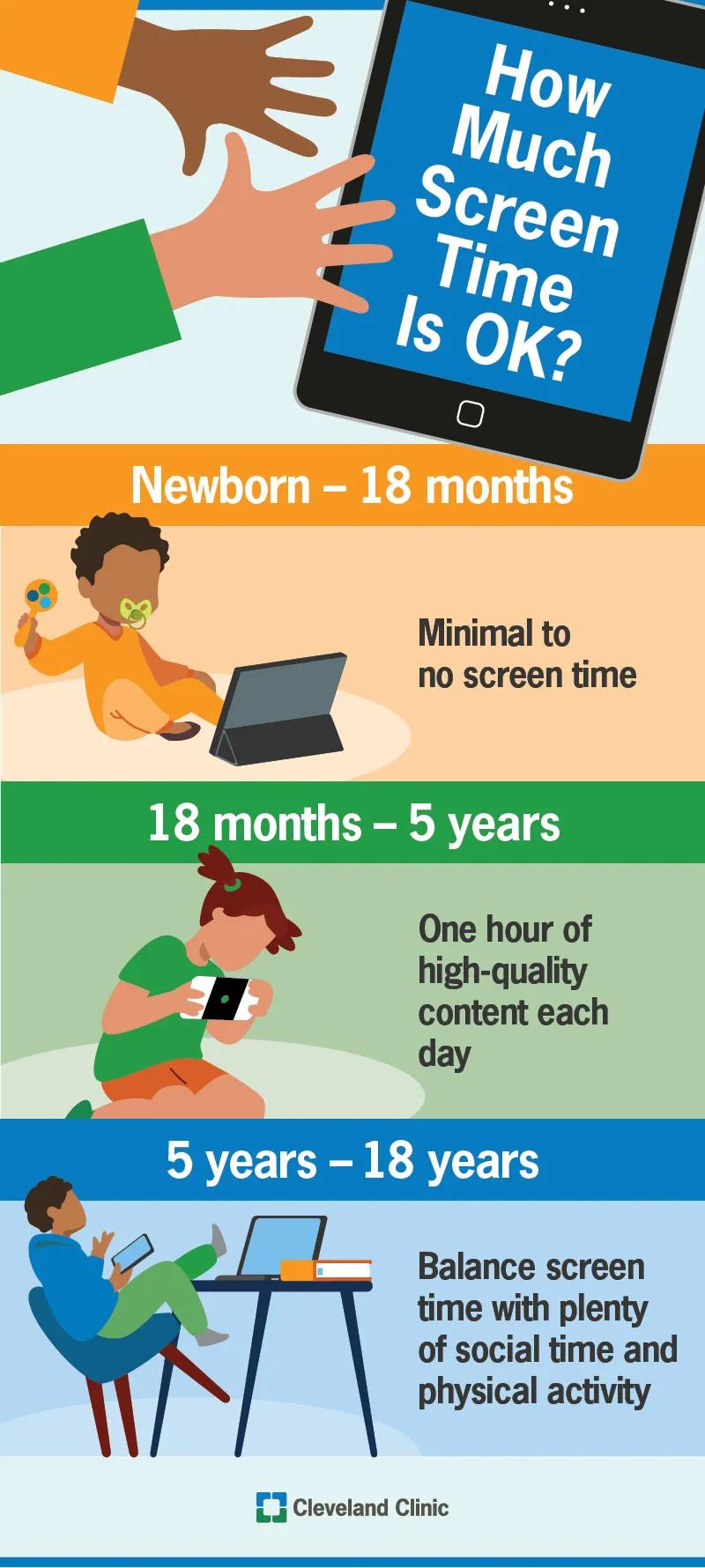
Recommended screen time by age
The American Academy of Pediatrics (AAP) has shifted away from measuring screen time by the clock alone. Today’s guidelines instead consider things like:
- Your child’s age
- The quality of the content they’re consuming
- Family involvement in their screen time
- Healthy boundaries between screen time and other activities
It’s an acknowledgment that not all screen time is the same.
Kids use screens to do schoolwork, to research their interests, to keep up with their friends and more. They can also use them for less-productive reasons, of course.
So, considering why and how they’re using technology is important to determining whether they’re consuming too much of it.
“Talking to grandparents on FaceTime or reading an eBook is a much more engaging and positive experience for toddlers than vegging out in front of the TV. And learning how to code is a more positive use of screentime for teens than doomscrolling on social media,” Dr. Schwartz illustrates.
Consider these recommendations:
- Under 18 months: Aim for minimal to no screen time.
- 18 months to 5 years: Encourage no more than one hour of high-quality content each day. Watch together whenever possible.
- 5 years and up: Focus less on a specific timeframe and more on balance. Screen time shouldn’t replace sleep, exercise, homework, family time or in-person social interactions.
Negative effects of excessive screen time on child development
A little screen time won’t derail your child’s development. But staying glued to a tablet for hours can create problems, especially when digital entertainment becomes the default.
“There’s a difference between using screen time as a tool so you can get dinner on the table and using it as a babysitter,” Dr. Schwartz notes.
He shares some ways that excessive screen time can affect your kids.
Social and language development
There’s a reason that healthcare professionals recommend strict limits on screen time for the youngest of children. It’s this: Children learn to talk and identify social cues as they interact with parents, caregivers and other real-life people. Screens can’t replace that experience.
“Younger kids need back-and-forth interaction,” Dr. Schwartz says. “They need those responsive, emotional connections to develop language and learn social cues.”
Sure, some children’s programs try to mimic two-way communication by asking questions and pausing for a response. But that’s no substitute for real-life, face-to-face conversation.
Sleep
Stimulating content and lights from screens can make it harder for kids to fall asleep and stay asleep.
“Sleep is so important to growing children, but screens are constant stimulation, especially if used close to bedtime,” Dr. Schwartz says.
That’s why experts recommend keeping bedrooms screen-free zones and avoiding screens for at least an hour before bedtime.
Physical activity
Kids are built to move — to run, jump, roll around in the grass and do it all over again.
Time spent staring at a screen often means less time moving their body. (After all, there are only so many hours in a day.)
“If the kid is camped out in front of the TV for hours on end, that’s time they aren’t spending being physically active,” Dr. Schwartz states.
Kids need to exercise to build muscle, develop coordination and grow properly. Excessive screen time can also lead to mindless snacking and poorer eating habits, which don’t contribute to a healthy, active life.
Mental health
As children grow into tweens and teens, the concerns about too much screen time extend beyond their physical health.
Research has linked excessive screen use and social media exposure to higher rates of mental health challenges, like:
- Anxiety
- Depression
- Bullying behavior
- Negative body image
Again, the quality of content matters. Social media feeds, endless scrolling and algorithm-driven videos in particular can expose kids to content that may not be healthy, age-appropriate or good for their emotional well-being.
Alternatives to screen time
Limiting screen time is all about creating a healthy balance.
The good news? Kids don’t need elaborate plans or expensive activities to pull them away from a screen. You can try:
- Getting outside: Go for a walk, visit a playground, ride bikes or explore a local park.
- Reading together: Books provide entertainment, language development and quality family time.
- Playing games and doing puzzles: Board games, blocks and puzzles help build creativity and problem-solving skills.
- Encouraging free play: Unstructured play helps children explore, learn and develop independence.
When your child does use screens, Dr. Schwartz recommends making it an intentional experience by:
- Watching shows together when you can, and talking about what you’re seeing.
- Creating screen-free times and spaces, like during family meals and before bedtime.
- Modeling healthy tech habits to help them develop their own. If you want them to put down their phones, make sure you’re willing to do the same.
Final thoughts
If you’re wondering whether your child is getting too much screen time, the answer may be less about calculating the exact number of hours and more about considering what their screen time is replacing.
When screens crowd out sleep, exercise, social connection and real-world experiences, it’s not just the screen that’s the problem — it’s everything your child is missing out on.
That doesn’t mean parents need to go zero-tolerance on the TV.
“Sometimes, screens are a practical tool that helps busy families get through the day, and you don’t have to feel guilty about your kids engaging with technology in a healthy way,” Dr. Schwartz recognizes.
“The goal doesn’t have to be to eliminate screens. It’s to make sure they’re a complement to a healthy, active childhood — not the default setting.”
This article was written by Cleveland Clinic Health Essentials (editorial@ccf.org) from Cleveland Clinic and was legally licensed through the DiveMarketplace by Industry Dive. Please direct all licensing questions to legal@industrydive.com.


