


When anxiety starts to build, your thoughts can easily spiral into a tornado of what-ifs. Grounding techniques aim to do the opposite — turning your attention away from hypothetical worries so you can focus on here-and-now realities instead.
Integrative medicine physician Melissa Young, MD, explains how one of these strategies, known as 5-4-3-2-1 grounding, can be a helpful tool for calming a storm of racing thoughts.
What is the 5-4-3-2-1 grounding technique?
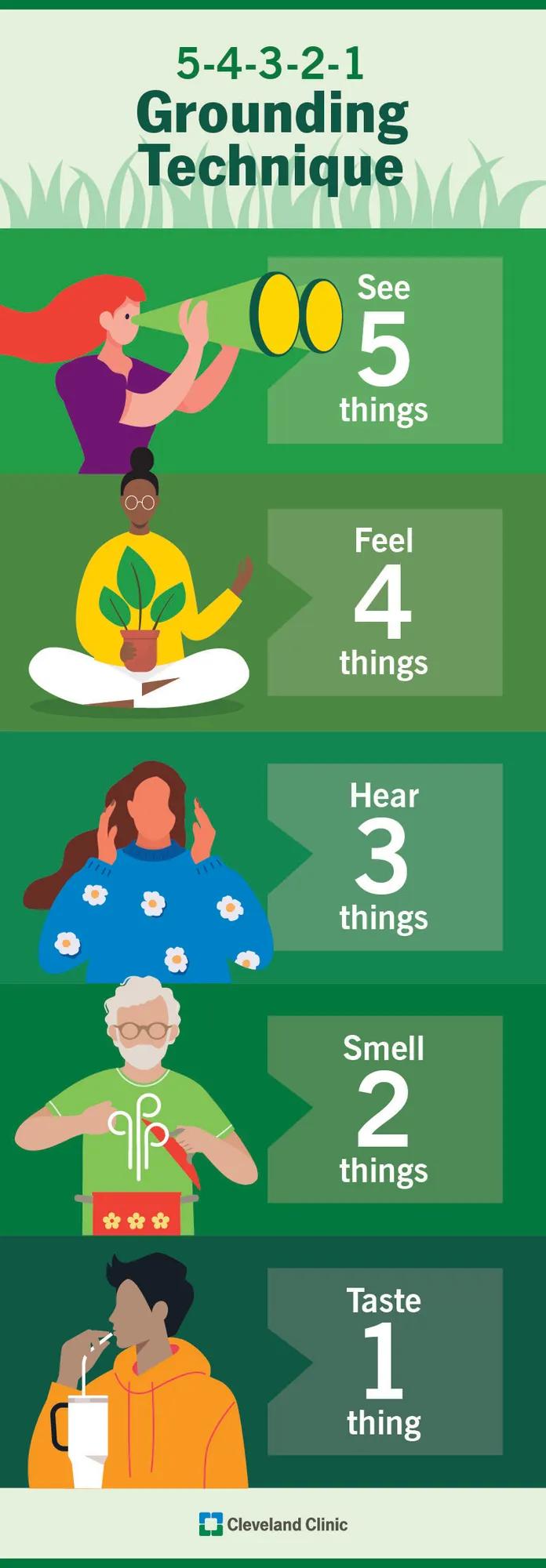
The 5-4-3-2-1 grounding technique is a mindfulness exercise. It engages each of your five senses to help interrupt overwhelming emotions like anxiety, anger or sadness. As with other grounding strategies, the goal is to anchor your attention on the present moment to reduce racing thoughts and emotional reactivity.
“Anxiety and worry are usually about what might happen in the future, or what happened in the past — not what’s happening right now,” Dr. Young explains. “Grounding techniques like 5-4-3-2-1 bring you into the present moment.”
The exercise follows a simple pattern where you acknowledge:
- Five things you see
- Four things you feel
- Three things you hear
- Two things you smell
- One thing you taste
As you do it, keep this in mind: Perfection isn’t the goal. There’s no reward for correctly identifying a magical number of things with each of your senses. It’s more about bringing your awareness to each of your senses in a systematic way.
“The numbers are really just a way to frame your thoughts,” Dr. Young clarifies. “It doesn’t have to be that literal. But the more you engage your senses, the more your attention moves into the present moment.”
She walks us through each step.
5 things you can see
Start by looking around you and (silently or out loud) name five things you can see. Don’t just glance at them. Spend a moment noticing details.
For example, instead of simply thinking I see my backpack, you might notice that it’s green and blue, has silver zippers and is leaning against a chair.
You may also notice things like:
- A coffee mug that’s half full
- A big, leafy tree outside your window
- A framed photo of your family on vacation
- Your red running shoes
- The freckles on your arm that vaguely resemble the Big Dipper
4 things you can touch
Next, notice four things you can physically feel. This could be the texture of your shirt, how your feet feel against the floor or the support of your chair against your back.
Other ideas include:
- The soft breeze on your neck
- A smooth desk surface
- A cool glass of water
- The rough texture of a paper napkin
Take a moment to appreciate how each feels against your skin, rather than rushing through the list.
3 things you can hear
Now, focus on the sounds around you. You don’t have to search for noises or create them. Just notice what’s already there.
You might hear:
- Your refrigerator running
- Birds chirping at your window
- Your pet walking across the floor
“There isn’t a right or wrong answer,” Dr. Young reiterates. “It’s simply what’s in your immediate environment.”
2 things you can smell
Next, identify two scents.
Sometimes that’s easy, like smelling coffee brewing or a nearby vase of flowers. Other times, you may notice the scent of your soap, shampoo or even the fresh air outside.
If you don’t notice much at first, that’s OK. Again, the goal is simply to pause and pay attention.
1 thing you can taste
Finally, notice one taste. Maybe it’s the lingering flavor of your toothpaste, a sip of tea or coffee or a mint you’ve been sucking on.
How effective is 5-4-3-2-1 grounding?
“Grounding is a common practice used in therapy to help interrupt anxious thought patterns and reduce emotional distress,” Dr. Young explains. “It can help to have someone focus on something other than difficult emotions so they can work through them from a place of calm.”
Like other stress management practices, this technique tends to work best when you practice it regularly — not only when you’re feeling overwhelmed.
“The idea is that the more you practice, the more it can help your nervous system learn how to move into a calmer state,” she adds.
Even a few minutes each day may help make the technique feel more natural when you need it.
When to use it
You can do 5-4-3-2-1 grounding almost anywhere. Sure, you can go full-on meditation and sit cross-legged on the floor. But you can also try it while sitting at your desk or riding the bus to work.
You might turn to grounding when you’re:
- Feeling nervous before giving a presentation
- Waiting in a long line
- Feeling overwhelmed at work
- Managing a toddler in the midst of a tantrum
Engaging the 5-4-3-2-1 grounding technique can be most helpful when you first notice anxiety, anger or sadness — before those feelings really gain steam.
“The sooner, the better,” Dr. Young advises. “It’s easier to calm yourself when you’re coming down from a 10 than when you’re coming down from 100.”
She emphasizes that grounding works best as part of an overall approach to mental health.
If anxiety is becoming difficult to manage or interfering with your daily life, don’t rely on grounding techniques alone. Talk with a healthcare provider or mental health professional about the treatment options that may be right for you.
This article was written by Cleveland Clinic Health Essentials (editorial@ccf.org) from Cleveland Clinic and was legally licensed through the DiveMarketplace by Industry Dive. Please direct all licensing questions to legal@industrydive.com.


